A high-performance solution for domestic hot water production
Domestic hot water accounts for a significant share of a household’s energy consumption. As energy costs continue to rise and energy efficiency becomes an increasingly important concern, more and more households are turning to higher-performance solutions for meeting their daily hot water needs.
A heat pump water heater, also known as a thermodynamic water heater, is now considered one of the most efficient alternatives to a traditional electric water heater. By harnessing the heat naturally present in the air, it produces domestic hot water for the home while helping to reduce energy consumption.
Suitable for both new-build homes and renovation projects, it provides a durable, cost-effective, and comfortable solution for meeting a household’s domestic hot water needs.
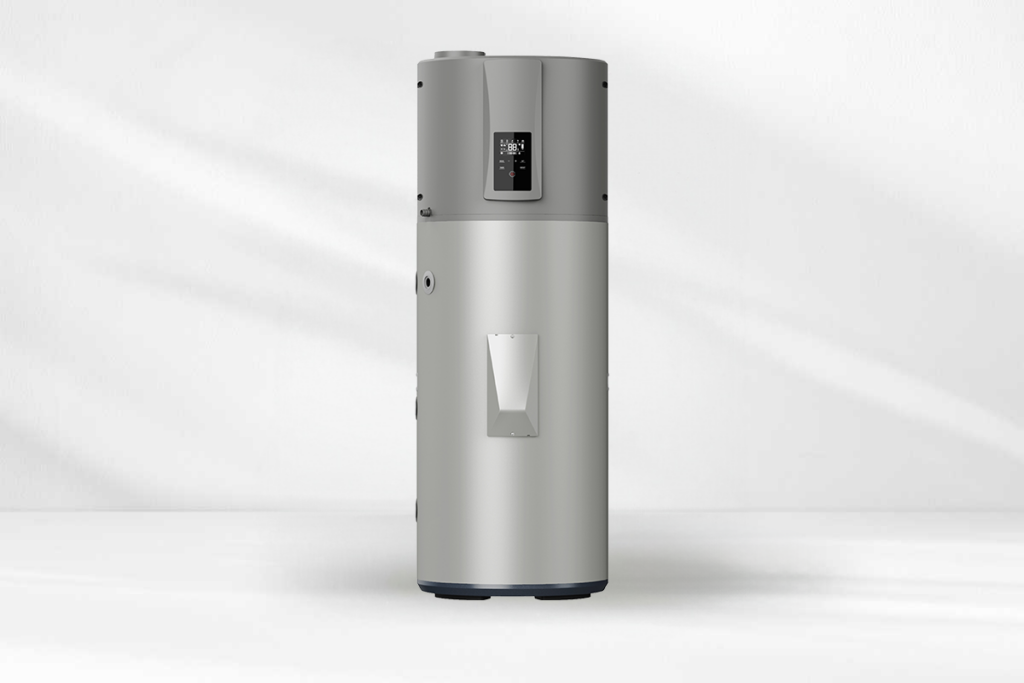
It combines a storage tank with an integrated heat pump that captures heat from the surrounding air and uses it to heat the water stored in the tank.
This technology provides the domestic hot water needed for everyday household use while consuming less energy than a conventional electric water heater.
The terms “heat pump water heater” and “thermodynamic water heater” refer to the same type of system. The former is more commonly used by homeowners, while the latter is often preferred by industry professionals.
1. Capturing Heat from the Air
The heat pump integrated into the water heater captures the heat naturally present in the surrounding or outdoor air.
2. Converting This Energy into Heat
The heat captured from the air is transferred to a refrigerant. Through the thermodynamic cycle, its temperature increases, generating the heat required to warm the water.
3. Heating the water stored in the tank
The heat produced is then transferred to the water stored in the tank, gradually heating it to the desired temperature.
4. Automatic hot water replenishment
When hot water is used in the home, it is automatically replaced by cold water, which is then reheated in turn.
Thanks to this technology, a heat pump water heater harnesses renewable energy naturally available in the environment. As a result, it consumes less electricity than a conventional electric water heater and can significantly improve a home's energy efficiency.
Unlike a conventional electric water heater, which generates heat solely from the electricity it consumes, a heat pump water heater captures the heat naturally present in the air.
This technology helps reduce the amount of electricity required to produce domestic hot water, contributing to improved energy efficiency throughout the home.
Domestic hot water is available every day to meet the household’s needs, whether for showering, bathing, cooking, or other everyday domestic uses.
A properly sized system helps ensure a level of comfort that meets the hot water consumption habits and needs of the household.
A heat pump water heater is an effective solution for replacing an outdated or energy-intensive electric water heater without requiring modifications to the home's entire heating system.
It is therefore an effective way to modernize domestic hot water production as part of a targeted renovation project.
A heat pump water heater is suitable for a wide range of applications:
It is a particularly attractive solution when the goal is to improve domestic hot water production without replacing or modifying the entire heating system.
However, each project should take into account the available space, the number of occupants in the home, and the household’s hot water consumption habits.
Choosing the right capacity for your heat pump water heater
Choosing the right tank capacity is essential to ensuring optimal comfort.
An undersized unit may not be able to meet the household’s daily hot water needs, while an oversized tank can result in unnecessary investment costs and less efficient use of the system.
Sizing mainly depends on:
A tailored assessment helps determine the capacity that best matches the actual domestic hot water needs of the household.
Monitoring operating parameters helps optimize equipment performance and facilitates certain maintenance operations.
At Warmeo, connected solutions provide greater visibility into system performance and help professionals monitor and manage equipment more effectively.
This approach helps improve technical support responsiveness and makes diagnostics easier whenever assistance is needed.
Its installation makes it possible to modernise domestic hot water production without the need for major work on the entire heating system.
When combined with other high-performance systems, such as an air-to-water heat pump, it contributes to improving the overall energy efficiency of the home.
Designed with both homeowners and professionals in mind, it provides a reliable and high-performance solution for meeting everyday domestic hot water needs.
None. Both terms refer to the same type of equipment. The term “heat pump water heater” is simply more commonly used by homeowners, while “thermodynamic water heater” is often preferred by industry professionals.
Yes. Thanks to its ability to capture heat naturally present in the air, a heat pump water heater consumes less electricity than a conventional electric water heater.
Most of the energy required to heat the water comes from a renewable resource that is naturally available in the environment. Electricity is primarily used to power the integrated heat pump and, when necessary, provide backup heating.
The savings achieved depend on several factors, including the household’s hot water demand, the tank capacity, its installation location, the temperature of the air being used as the heat source, and the quality of the installation. When properly sized, a heat pump water heater is therefore an efficient solution for achieving long-term reductions in the energy consumption associated with domestic hot water production.

The capacity of a heat pump water heater mainly depends on the number of occupants in the home, their hot water consumption habits, and the number of water outlets.
As a general guideline, a 200-litre tank is usually suitable for a medium-sized household, while a 250-litre model is better suited to the needs of a larger family or a household with higher hot water consumption.
WARMEO offers heat pump water heaters in 200- and 250-litre capacities, allowing homeowners to choose a solution that matches their domestic hot water needs. However, the final selection should be confirmed by a qualified professional to ensure proper sizing and optimal performance.
Yes. In fact, this is one of the most common installation scenarios.
Its operation requires electricity, but it also harnesses the heat naturally present in the air to produce hot water, which improves its overall energy efficiency.
Like any heating system, regular maintenance helps preserve its performance and extend its lifespan.
Remote monitoring helps simplify equipment oversight, improve support responsiveness, and enable professionals to diagnose and troubleshoot heating systems more efficiently.
Yes. These two systems are complementary and help optimize space heating and domestic hot water production respectively. When used together, a heat pump can efficiently provide heating for the home, while the heat pump water heater is dedicated to meeting the household’s domestic hot water needs. This combination can contribute to improved overall energy efficiency and enhanced comfort throughout the home.